
Polyester Part 1
- Marina Moore
- Jan 31, 2025
- 15 min read

The clothes we wear undergo a series of different stages in their lifecycle, raw material extraction, processing, manufacturing, and end-of-life. Each stage of the lifecycle yields different environmental impacts.

Coal is the dirtiest, most polluting rock, in the world.
A detailed knowledge of land use practices is essential to understand the land use pattern, its dynamics and implications for the management and planning of land, as well as policy making and infrastructure developmental initiatives. Yet, for those who work and live near coal mines, it is extremely dangerous and destructive to their health. Significant amounts of forest are lost, agricultural lands decreased along with the rich topsoil during pre-mining overburden removal and replaced by undesirable waste. This overburden is waste dumped and collected within the mining area forever altering the food availabilities and wildlife habitat.

Whatever’s left, the coal dust will settle affecting growth and any chance of renewal. Today’s modern mining technology productivity as improved, they now have the capability to pulverize thousands of tons of coal, which generate clouds of respirable dust particles, with toxic radicals on their surfaces. The release of toxic gases like methane, nitrogen oxides and sulphur dioxide polluting the surrounding air and hence deteriorate the air quality. These dust particles and gaseous pollutants when released into the atmosphere pose an immediate and potential threats to the mine workers as well as the nearby agriculture areas, cattle, livestock and the population at large. The harmful effects of these pollutants may also be aggravated by the prevailing meteorological conditions of the region (Roy et al 2019) (Hail et al 2019).
For decades mining’s environmental impact, the air and water quality, the change in land use have been well researched. Miners for instance, who are prone to respiratory diseases. The study by (Singh et al 2010) concluded that the mine workers suffer from various types of skin and respiratory problems which takes a toll on their overall health, living standards and working capability. Globally respiratory infection counts for 30% of death, 48% from chronic obstructive pulmonary disease 28% from ischemic heart disease. (healthdata.org, 2024). 1970s United States, coal mining resulted in nearly 30,000 cases of black lung disease every year. (Husseini, T. et al 2018) Deaths attributable to coal PM2.5 in the US Today.


Today ill health is prevalent among coal miners all around the world. So why does California transport 7.4 million tons of coal per-year from Utah mines by rail, which translates to 10 uncovered car per-week to the Port of Oakland, passing through densely populated areas
(Ostro, B, 2024)

The trans transportation of coal has been shown to significantly increase ambient fine particulate matter (PM2.5). (Ostro, B, 2024)

India respiratory infection counts for 36.67% of death (Akbar et al, 2024). The Jharia coalfield Dhanbad exposed pathways were the major causes of emission of these trace elements. (Singh G et al 2019) (Mondal S 2020) (Mondal s. 2021). It is well documented that particulate matters (PM) from coal is the underlying or contributing cause of deaths (Ayoglu F. N et al 2014), (Xia Y et al 2014), (Han, L. et al 2015), (Perret J. L. et al 2017), (Shu X H, 2018), (Wu Q. et al 2019), (Kumari, P. S. et al 2019), (Liu T. et al 2020), Among fossil fuels, coal is the largest source of this mortality (Vohra et al., 2021) (Huang X-Z et al 2022), (Lelieveld et al., 2023) (Xia, R. et al 2023)
We know during mining coal beds and surrounding strata are disrupted. The consequent these sulphide minerals get exposed to air and mine water and the resultant oxidation and hydrolysis leads to the generation of acid mine drainage. One of the most significant and severe environmental problems associated with the coal mining industry (Akcil, A. et al, 2006). India, presently about 70% production comes from open pit mines and 30% come from underground mines. The most affected part of the natural resources is water in this region and thereby human health. It is found that the majority of people in the mining areas are affected with water borne diseases. Huge amount of overburden materials has been dumped on the bank of the river, which finally get spread in the river especially in rainy season, resulting in the visible deterioration of the quality of the river water. Research from (Equeenudin et al, 2010) (Singh, G. et al. 2010) reported a detailed geochemical characterization of acid mine drainage and its impact on the water quality of various creeks, rivers and groundwater in the Makum Coalfield and Jhansi open cast mining site - Uttar Pradesh, India. As a result, the water bodies that were earlier beaming with life and biodiversity have now been deprived of aquatic life and no more contribute to their role in the ecosystem as life supporters. The degraded water now comprised of high concentrations of sulphate ions, toxic heavy metals (Gaurav, A. et al. 2014) (Kumar, A et al. 2016) (Upgupta, S. et al 2017) (Singh, N. S. 2019).
Our drinking water too, is under threat from mining waste polluting, rivers, fields, natural streams. Carbonate aquifers represent an essential source of water-supply worldwide. So, elevating the risk of groundwater contamination for human health in case of hazardous anthropic activities such as mining is essential, right. An investigation into well water quality was carried out in a rural area subject to irrigation with acidic mine water from the Guangdong Dabaoshan Mine, Southern China. The results of water pH measurements from 112 wells in two different seasons suggest that the well water has been contaminated (Chen, A. et al 2007). The Stockton coal mine on the West Coast of the South Island of New Zealand found in intense rainfall pyritic waste rock at the mine interacts chemically creating a significant environmental issue because of its impacts on water quality and stream biota. (Davies, H.2011). Thallium (Tl) for instance is a trace metal of severe toxicity. Scientist have gained sufficient evidence and insight into the actual level and distribution characteristics of Tl and metal (loid)s (Pb, Cd, Cr, Sb, Mn, Cu, Zn, Ni, and Co) in upstream, midstream, and downstream of a densely populated residential area of mine exploration in China, Italy and Spain. (Gomez-Gonzalez M A et al, 2015), (Cheng J et al: 2017), (Shu X H et al: 2018), (Ghezzi L et al 2019), (Doveri M et al 2021).
It’s not just our water, the health concerns via consumption of contaminated vegetables have often been overlooked or underestimated.
“The results show that most of the agricultural soils exhibit contaminated
levels of Tl, with Tl contents (upstream: 1.35–4.31 mg/kg, midstream:
2.43–5.19 mg/kg, and downstream: 0.65–2.33 mg/kg) mostly exceeding
the maximum permissible level (MPL) for agricultural land use (1 mg/kg)”.
(Liu J: 2019)
Large amounts of hazardous wastes generated by mining have penetrated the soils and ecosystem via various pathways due to inadequate waste management or inefficient pollution control (Swer, S. et al. 2004) (Altan, G. 2017 (Liu J: 2019), (Shu et al., 2018), (Vaněk et al., 2018).
We know that detailed knowledge of land use practices is essential to understand the land use pattern. Surface coal mining operations and all their activities degrade the land to considerable limits. Underground coal mining induces strata movement and in turn causes ground surface subsidence or fissures. Although most subsidence occurs in the months and years after mining, research found surface movement is still occurring many decades after (Vervoort, A. et al 2017) (Vervoort, A. et al 2018) (Dudek, M. et al 2020) (Vervoort, A. et al 2020). China’s Shendong mining area is one of the seven largest coalfields in the world. Mining-induced ground fissures develop frequently because of discontinuous deformation of the surface, which cause extensive damage to surrounding ecosystems and constitute a safety hazard during underground mining, resulting in seepage and loss of surface and soil waters (Liu, H. et al 2019) for which as consequently, triggered secondary geological disasters such as landslides and collapses, endangering people’s lives and property(Liu, H. et al 2019) (Mu, C. et al 2021) (Fu, Y. et al 2023).
Mining area in Yulin City, Shaanxi Province.

Hanjiawan coal mine Daliuta coal mine,
Shendong mining district of Western China.


(Mu, C. et al 2021

China, as the highest number of serious casualties and fatalities.
Fatalities in Chinese coal mines account for approximately 70% of global coal fatalities, (Liu, Q. et al 2021); statistics show that between 1991 and 2010, the total number of deaths due to coal-related activities was 108,697. This is equivalent to more than 6,000 people dying each year from coal mines, more than three times the total number of the other coal producing countries in the world. (Xiao, W. et al 2018)

Now fires. The overburden dumps sometimes ignite spontaneously releasing unwanted gases into the atmosphere which in turn affects the air quality to considerable limits and when fissures appear the coal under the earth's surface become exposed to oxygen and can catch fire. Across the globe they are hundreds of fires burning above and beneath the earth. These fires are known as coal seam fires. Those beneath are often hard to detect at first due to the out-of-sight nature of the fires, they, are even harder to extinguish. Unlike forest fires, coal seam fires release large quantities of toxic fumes such as mercury, methane, carbon monoxide and carbon dioxide which are present in the coal and can be deadly. The residence time can range from few days to two years in the atmosphere. Carbon monoxide, known as the silent killer, can cause flu-like symptoms and often death without warning.
Underground fire causing split in Highway 61 in Pennsylvania

Atmospheric mercury from the underground coal seam fire in the Wuda, Inner Mongolia China was mapped with different mercury concentration values, those closer to coal seams had higher values on average (Liang, Y. et al 2014). It seems the coal industry concentrates more on extraction than the management of the surrounding environment. Decades of research show the same results with the reoccurrence of serious heavy metals like mercury poisoning every part of the environment. Analysis of China’s Suzhou, Wuxi, and Changzhou show that the mercury emission from coal accounting for 40.99% of the total circulation. The amount of mercury circulating in Suzhou accounted for 47.88% of the total regional emissions, while the mercury concentration in Wuxi soil is slightly higher than the first-level soil quality standard (Zhang, T. et al 2022)
With all that we know. Transitioning away from coal will undoubtedly benefit the environment. Over the past 20, 30 years an increasing concern about the threats that environmental deterioration poses to the planet had galvanized. We thought. We have seen the international response as scientists, governments, global leaders, policy makers, intergovernmental organizations, and other stakeholders coalesced around an urgent need to act. Or NOT

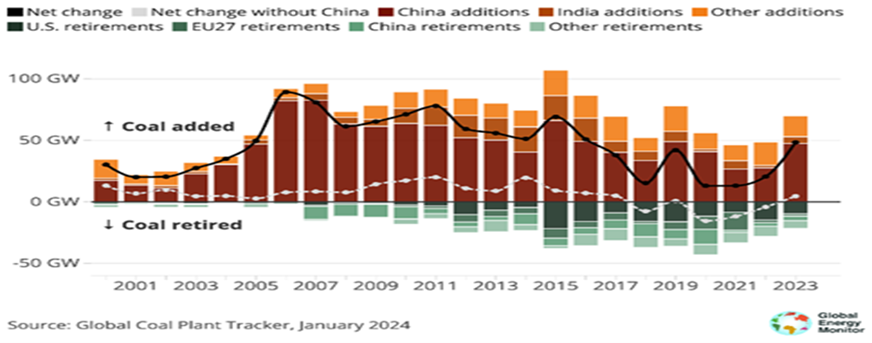
The 2015 Paris Climate Change Agreement, countries agreed to reduce greenhouse gas emissions, to focus on renewable energy sources and substantially decline the use of fossil fuels consumption and production. Come 2021, Cop2026 climate summit, watered down the commitment to end the use of fossil fuels like coal. Coal consumption, 2021 increased by 1.2% on the previous year, reaching records worldwide of 8 billion tons, with China, India, and the USA being the major coal-consuming countries. Asia plays an important role in both the supply and demand of coal worldwide. China, India, and Indonesia produced 71.9%, 5.75 billion tons (Akbar KA et al: 2024). Come 2023 globally the operating coal capacity grew further, 2%. China driving two-thirds of new additions, according to Global Energy Monitor's.


Total 1,147,231
Total 239,645

Data from Global Coal Plant Tracker highlights the continuous growth of coal mines in operation and of new openings. New coal mines opened in Bangladesh, China, India, Indonesia, Mongolia, Philippines, South Africa, South Korea, Vietnam and Zimbabwe. In total 15,586.

China alone employs more than 1,469,641 miners, India 136,897, Indonesia 125,538 United States 23,527 (coal, GEM). While the number of coal miners in the United States may be significantly lower due to mechanization, but with Donald Trump’s Presidency that figure is expected to rise. The United States holds 28% of the world’s recoverable coal reserves, mining employment is likely to remain for many years. (Petsonk et al, 2013)

While the environmental and health effects of coal are well understood. The coal industry is a powerful stakeholder with vested interests in delaying phase-out of coal. Cop26 is an example of the political influence of owners of coal mines and power producers that shape the policymakers. Who often then highlight the importance of coal for industrial development in specific regions. The industrializing countries like India desire to protect jobs and public budgets dependence from coal mine royalties. Regions with abundant coal resources China, India and the United States have favoured the continuing investment in coal assets, insuring security of supply. Why you may ask!
Part 2 .... From Coal To
Reference:
Akbar KA, Kallawicha K. (2024). “Black Lung Disease Among Coal Miners in Asia”: A Systematic Review. Safety and Health at Work, Volume 15, Issue 2, Pages 123-128
Ayoglu F. N, Acikgoz B, Tutkun E, Gebedek S. (2014) “Descriptive characteristics of
coal workers’ pneumoconiosis cases in Turkey”. Iran J Public Health;43(3):389.
Altan, G. Monika, M. Bogusław, W. Małgorzata, S-M. (2017). “ENVIRONMENTAL AND SOCIAL CONSEQUENCES OF GOLD MINING IN MONGOLIA”. Monitoring Środowiska Przyrodniczego. Vol. 19(1), s. 11-15
Akcil, A. Soner Koldas, S. (2006) Acid Mine Drainage (AMD): causes, treatment and case studies, Science Direct Journal of Cleaner Production Volume 14, issue 12-13, Pages 1139-1145. https://www.sciencedirect.com/science/article/abs/pii/S0959652605000600
Chen, A. Lin, C. Lu, W. Wu, Y. Ma, Y. Li, J. Zhu, J. (2007) “Well water contaminated by acidic mine water from the Dabaoshan Mine, South China: Chemistry and toxicity” Science Direct, Cheophere, Volume 70,Issue 2, Pages 248-255. https://www.sciencedirect.com/science/article/abs/pii/S0045653507008077
Cheng J, Zhang X, Tang Z, Yang Y, Nie Z, Huang Q (2017) “Concentrations and human health implications of heavy metals in market foods from a Chinese coal-mining city”. Science Direct Environmental Toxicology and Pharmacology Volume 50, Pages 37-44.
Davies, H. Weber, P. Lindsay, P. Craw, D. Pope, J (2011 “Characterisation of acid mine drainage in a high rainfall mountain environment, New Zealand”. Science direct, Science of The Total Environment, Volme 409, Issue 15, Pages 2971-2980.
Doveri M, Natali S, Franceschi L, Menichini M, Trifirò S, Giannecchini R (2021) “Carbonate aquifers threatened by legacy mining: hydrodynamics, hydrochemistry, and water isotopes integrated approach for spring water management”. Science Direct Journal of Hydrology Volume 593, 125850.
Dudek, M. Tajduś, K. Misa, R. Sroka, A. (2020) “Predicting of land surface uplift caused by the flooding of underground coal mines— A case study”. International Journal of Rock Mechanics and mining Sciences, Volume 132. https://www.sciencedirect.com/science/article/abs/pii/S1365160919307038
Equeenuddin, S. K. Tripathy, S. Sahoo, p. K. Panigrahi, M. K. (2010) “Hydrogeochemical characteristics of acid mine drainage and water pollution at Makum Coalfield, India”. Journal of Geochemical Exploration, Volume 105, issue 3. Pages 75-82
Fu, Y. Wu, Y. Yin, X. Zhang, Y. (2023) “Mapping mining-induced ground fissures and their evolution using UAV photogrammetry”. China Coal Research Institute, Beijing, China.
Gaurav, A. Khan, I. A. (2014). “Impacts of Coal Mining on Vegetation and Water Quality”. The International Journal of Science & Technology, Volume 2, Issue (4). https://www.internationaljournalcorner.com/index.php/theijst/article/view/138624
Ghezzi L et al 2019 Ghezzi L, D'Orazio M, Doveri M, Lelli M, Petrini R, Giannecchini R (2019).
“Groundwater and potentially toxic elements in a dismissed mining area: Thallium contamination of drinking spring water in the Apuan Alps (Tuscany, Italy)” Science Direct journal of Geochemical Exploration Volume 197, Pages 84-92
(GEM (2024) “Boom and Bust Coal: Tracking the Global Coal Fleet”.
Global Energy Monitor: https://globalenergymonitor.org/report/boom-and-bust-coal-2024/
(GEM) Global Energy monitor: https://globalenergymonitor.org/projects/
Coal GEM (Oct 2024); https://globalenergymonitor.org/projects/global-coal-mine-tracker/
Gomez-Gonzalez M A, Garcia-Guinea J, Laborda F, Garrido F (2015) “Thallium occurrence and partitioning in soils and sediments affected by mining activities in Madrid province (Spain)”. Science Direct Science of the Total Environment Volume 536, Pages 268-278.
Hall N. B, Blackley D. J, Halldin C. N, Laney A, S. (2019) “Continued increase in prevalence of r-type opacities among underground coal miners in the USA”. Occup Environ Med. doi: 10.1136/oemed-2019-105691
Healthdata. Org 2024-06: The State of Global Air 2024.
Institute for Health Metrics and Evaluation
https://www.healthdata.org › sites › files › 2024-06
Huang X-Z, Wang D-M, Liang R-Y, Dong C-Q, Zhang Y-D. (2022) “Study on the burden of coal workers’ pneumoconiosis in China from 1990 to 2019”. Chin J Dis
Control Prevent;26(8):876e81.
Husseini, T. (2018) “Studying the health effects of underground coal dust” mining technology. https://www.mining-technology.com/features/studying-health-effects-underground-coal-dust/?cf-view
Kumar, A. Singh, P. K. (2016) “Qualitative Assessment of Mine Water of the Western Jharia Coalfield Area, Jharkhand, India”. Current World Environment; Volume 11, Issue (1). https://www.cwejournal.org/pdf/vol11no1/Vol11_No1_p_301-311.pdf
Kumari Prasad S, Singh S, Bose A, Prasad B, Banerjee O, Bhattacharjee A,
Kumar Maji B, Samanta A, Mukhejee S. (2019) “Combined effect of coal dust exposure and smoking on the prevalence of respiratory impairment among coal
miners of West Bengal, India”. Arch Environ Occupant Health;74(6):350e7.
Lelieveld, J. Haines, A. Burnett, R. Tonne, C. Klingmüller, K. Münzel, T. Pozzer, A.
(2023) “Air pollution deaths attributable to fossil fuels: observational and modelling study” BMJ 383, e077784.
Liang, Y. Liang, H. Zhu, S. (2014) “Mercury emission from coal seam fire at Wuda, Inner Mongolia, China”. Science Direct, Atmospheric Environment, Volume 83, Pages 176-184.
Li, W. Shuai, C. Chen, X. Huang, W. Hou, W. Sun, J. Zhao, B. (2024) “Decoding China’s industrial water use: sectoral demand-driven impact and scarcity nexus”. Stochastic Environmental Research and Risk management. https://doi.org/10.1007/s00477-024-02829-6
Liu, H. Zhou, T.T. Liu, X. Deng, K.Z. Lei, S.G. (2019) “Factors that trigger the development of mining-induced ground fissures, and standards to treat them in shallow coal mining areas”. Journal South African Institute of Mining and Metallurgy. 119, (1)
Liu, Q. Li, X. Hassall, M. (2021) “Regulatory regime on coal Mine Safety in China and Australia: Comparative analysis and overall findings” Science Direct, Resources Policy, Volume 74.
Liu J, Nuo Li N, Zhang W, Wei X, Tsang D. C. W, Sun Y, Luo X, Bao Z, Zheng W, Wang J, Xu G, Hou L, Chen Y, Feng Y. (2019) “Thallium contamination in farmlands and common vegetables in a pyrite mining city and potential health risks” Science Direct Environmental Pollution, Volume 248, Pages 906-915.
Liu T, Liu S. (2020) “The impacts of coal dust on miners’ health: a review”. Environ Res; 190:109849.
Mondal S, Singh G, Jain MK (2020) “Spatio-temporal variation of air pollutants around the coal mining areas of Jharia Coalfield, India”. Environ Monit Assess 192:405. https://doi.org/10.1007/s10661-020-08324-z
Mondal S, & Singh G (2021) “Pollution evaluation, human health effect and tracing source of trace elements on road dust of Dhanbad, a highly polluted industrial coal belt of India”. Environ Geochem Health 1-23.
Mu, C. Yu, X. Zhao, B. Zhang, D. (2021). “The Formation Mechanism of Surface Landslide Disasters in the Mining Area under Different Slope Angles”. Advance in Civil Engineering
Ostro, B. Fang, Y. Sospedra, M. C. Kuiper, H. Ebisu, K. Spada, N. (2024)
“Health impact assessment of PM2.5 from uncovered coal trains in the San Francisco Bay Area: Implications for global exposures”. Science Direct, Environmental Research, Volume 252, Part 1
Perret J. L, Plush B, Lachapelle P, Hinks TS, Walter C, Clarke P, Irving L, Brady P,
Dharmage SC, Stewart A. (2017) “Coal mine dust lung disease in the modern era”.
Respirology;22(4):662e70.
Petsonk E. L, Rose C, Cohen R. (2013).” Coal mine dust lung disease. New lessons from old exposure”. Am J Respir Crit Care Med;187(11):1178-85. DOI: 10.1164/rccm.201301-0042CI
Roy. D, Singh. G, Seo. Y (2019) “Coal mine fire effects on carcinogenicity and non-carcinogenicity human health risks”. Environmental Pollution Volume 254, Part B, 113091. https://doi.org/10.1016/j.envpol.2019.113091
Schultz, A. (2022) “Risks and Vulnerabilities From The Underground Fires Burning Across the World”
Shu X H, Zhang Q, Lu G, Yi X, Dang Z (2018) “Pollution characteristics and assessment of sulfide tailings from the Dabaoshan Mine, China” Science Direct, International Biodeterioration and Biodegradation Volume 128, Pages 122-128.
Singh, N. S. (2019) “Impact of Open Cast Coal Mining on Air and Water Environment and its Management”. International Journal of Scientific Research in Science, Engineering and Technology, Volume 6, Issue 4.
Singh, G. Pal, A. Niranjan, R. K. Kumar, M. (2010) “Assessment of environmental impacts by mining activities: A case study from Jhansi open cast mining site - Uttar Pradesh, India”. Journal of Experimental Sciences, Volume 1, Issue 1, Pages 09-13.
Singh G, Roy D, Seo YC (2019) Carcinogenic and non-carcinogenic risks from PM10-and PM2. 5-Bound metals in a critically polluted coal mining area. Atmos Pollut Res 10(6):1964–1975. https://doi.org/10.1016/j.apr.2019.09.002
Swer, S. Singh, O. P. (2004). “Water quality, availability and aquatic life affected by coal mining in ecologically sensitive areas of Meghalaya”. https://www.researchgate.net/publication/215765707
Upgupta S, Singh P. K. (2017) “Impacts of Coal mining: a Review of Methods and Parameters Used in India”. Current World Environment, Volume 12, Issue (1).
Vaněk A, Grösslová Z, Mihaljevič M, Ettler V, Truba J, Chrastný V, Penížek V, Teper L, Cabala J, Voegelin A, Zádorová T, Oborná V, Drábek O, Holubík O, Houška J, Pavlů L, Ash C. (2018) “Thallium isotopes in metallurgical wastes/contaminated soils: A novel tool to trace metal source and behaviour” Science Direct Journal of Hazardous Materials Volume 343, P ages 78-85.
Vervoort, A. Declercq, P.Y. (2017) “Surface movement above old coal longwalls after mine closure”. International Journal of Mining Science and Technology, Volume 27, Issue 3, Pages 481–490. https://www.sciencedirect.com/science/article/pii/S2095268617302306
Vervoort, A. Declercq, P.Y. (2018) “Upward surface movement above deep coal mines after closure and flooding of underground workings”. International Journal of Mining Science and Technology, Volume 28, Issue 1, Pages 53–59.
Vohra, K. Vodonos, A. Schwartz, J. Marais, E. A. Sulprizio, M. P. Mickley, L. J. (2021) “Global mortality from outdoor fine particle pollution generated by fossil fuel combustion: results from GEOS-Chem”. Science Direct, Environmental Research, Volume 195, 110754
Wu Q, Han L, Xu M, Zhang H, Ding B, Zhu B. (2019) “Effects of occupational exposure to dust on chest radiograph, pulmonary function, blood pressure and electrocardiogram among coal miners in an eastern province, China”. BMC Public Health 2019;19(1):1e8.
Xia, R., Wang, R., Hasa, B. Lee,A Liu, Y. Ma, X. Jiao, F. (2023). “Electrosynthesis of ethylene glycol from C1 feedstocks in a flow electrolyzer”. Nature communications Volume 14, Article number: 4570 .
Xia Y, Liu J, Shi T, Xiang H, Bi Y. (2014) “Prevalence of pneumoconiosis in Hubei, China from 2008 to 2013”. Int J Environ Res Public Health;11(9):8612e21.
Xiao, W. Xu, J. Lv, X. (2018). “Establishing a georeferenced spatio-temporal database for Chinese coal mining accidents between 2000 and 2015”. Geomatics, Natural Hazards and Risk.
Zhang T, Tian G, Hu X, Liu B, Guo Y, Zhang L, Bian B. (2022) “Analysis of mercury emissions and cycles in typical industrial city clusters: a case study in China”. Environmental Science and Pollution Research 29, 56760–56771. https://doi.org/10.1007/s11356-022-19878-5
Comments